วันอาทิตย์ที่ 6 มกราคม พ.ศ. 2556

[rael-science] Our robotic revolution is only just beginning to gather steam


~~~~~~~~~~~~~~~~~~~~~~~~~~~~~~~~~~~~~~~~~~~~~~~~~~~~~~~~~~~~~~~~
The Raelian Movement
for those who are not afraid of the future : http://www.rael.org
~~~~~~~~~~~~~~~~~~~~~~~~~~~~~~~~~~~~~~~~~~~~~~~~~~~~~~~~~~~~~~~~
Get Rael-Science on Facebook: http://www.facebook.com/raelscience
~~~~~~~~~~~~~~~~~~~~~~~~~~~~~~~~~~~~~~~~~~~~~~~~~~~~~~~~~~~~~~~~

Contributed by Mehran Sam
Source: http://www.telegraph.co.uk/comment/9778354/Our-robotic-revolution-is-only-just-beginning-to-gather-steam.html

Our robotic revolution is only just beginning to gather steam

Robots offer the potential for unlimited economic growth - as well as a helping hand about the house

One of the most fashionable ideas in economics right now is the “end of growth”. This is perhaps only to be expected given the challenges we face, with the barriers to recovery in many advanced economies apparently insurmountable.
One is reminded of John of Gaunt’s soliloquy in Richard II where he laments England’s decline from “scepter’d isle… set in the silver sea” to “like to a tenement or pelting farm… bound in with shame, with inky blots and rotten parchment bonds”. Declinism is very much on the up at the moment, but it is also a cyclical phenomenon; there have been many occasions throughout history when there seemed no hope for the future.
All the same, there are some quite good reasons for believing it might be true this time, and they are argued in highly persuasive terms by one Robert Gordon, a US academic whose thoughts have gone viral on the internet in recent months. Professor Gordon’s big observation is that far from being the norm, longish periods of sustained, per capita income growth are in fact comparatively rare, and are, in virtually all cases, caused by profound technological change.
The modern age has been characterised by three such revolutions. First came steam, cotton spinning, the railways and the other breakthroughs of Britain’s early industrial and agrarian revolutions. After that came mass sanitation, electrification, the motor car, aeronautics, and the jet engine, all driven primarily by tapping into energy-rich hydrocarbons. And more recently we’ve had the breakthroughs of modern computing and communications.
The second of these revolutions was by far the most significant, transforming and improving the lives of ordinary people in ways their forebears could barely have imagined. The third, according to Professor Gordon, has not been nearly so transformational in terms of its impact on labour productivity, and is now fast running up against the law of diminishing returns.
Social media may have its merits, but as far as advanced economies are concerned, it has failed to add significantly to output and wealth. In any case, for Professor Gordon, the easy gains of the IT revolution – back-office automation, supermarket checkouts, and so on – have largely been and gone.
To my mind, this is where his theories break down. Most of those who actually work in computing think the IT revolution has barely begun. The potential productivity gains from smart machines driven by artificial intelligence – or to use the more emotive term, robots – are at least as great as any of the other revolutions.
Indeed, it is probably a mistake to think of these transformational technologies as separate events. A better way to view the march of technology is as a seamless progression of mechanical developments, starting with machinery for labour-saving functions such as lifting water and grinding grain, through to today’s legion of electro-mechanical devices, from the vacuum cleaner to the articulated welding robots that populate the automotive production lines.
The robots are already with us, but they are still in a quite underdeveloped phase. My interest in them was sparked on a visit to Japan a couple of years ago, where I observed a miniature, humanoid-type robot navigate a zigzag, elevated pathway on a small bicycle, using artificially generated sight, co-ordination and balance functions.
It was an impressive feat that would have foxed many biological humans. This robot couldn’t think for itself but it was capable of some highly complex, reactive movements strictly reserved, until now, for those of Darwinian origin.
Japan sees robotics as very much the future, and is investing in its development accordingly. This is not just for economic advancement. Japan also thinks of robots as a viable alternative to mass immigration.
No, seriously. For the notoriously insular Japanese, the idea of a friendly robot in the house to see to your every need is widely thought far preferable to a culturally alien immigrant. As we grow older, and can do fewer things for ourselves, we need servants. An artificial one, bought in much the same way as a car, provides a possibly better, less costly and less intrusive solution than a human one.
These musings are still the stuff of science fiction. We are a million miles away from the sort of fully functioning human robots you see in Ridley Scott and James Cameron movies, but the direction of travel is clear. And we are moving towards this future at a much faster pace than many imagine. Artificial intelligence, from voice recognition to primitive forms of sight and cognitive ability, is coming on in leaps and bounds. These developments have potentially massive macro-economic significance – positive and negative. On the positive side, the march of the robots should progressively free humans from everyday chores. It also creates the potential for virtually unlimited economic growth. The more robots you have, the higher your potential output.
But like all work-saving machinery, robots could also help create mass unemployment, rather in the way that the addition to the global labour force of billions of low-paid workers from previously closed Asian economies has undermined many basic jobs in the West.
Some see this threat in apocalyptic terms. Marshall Brain, a US analyst whose pamphlet Robotic Nation has done much to popularise the idea of an automated future, reckons that the rapid evolution of computer technology over the next decade or two could end up costing around a half of all current US jobs, or something in the region of 50 million full-time positions.
Exaggerated this claim might be, but you get the point. As robots spread ever deeper into the workforce, it is not clear what the humans they displace will end up doing. If it is a life of eternal leisure we are all heading for, some very dramatic changes in political and social models would be needed to accommodate it.
Some of the more negative social consequences of growing automation are apparent in a widening income and wealth divide. Companies are becoming less labour – and more capital – intensive, driving corporate profits as a share of GDP to record levels in many advanced economies. Labour’s share of GDP is shrinking. Yet these are phenomena closely associated with the initial stages of all industrial revolutions. Each one has been accompanied by similar concern about jobs, but ultimately society tends to find ways of sharing the spoils more equitably, and all of them have ended up creating far more employment in new industries than they have destroyed in old ones.
You have to be of a peculiarly pessimistic frame of mind to think the march of technology is going to end up doing us more harm than good. That’s not been the experience to date. In nearly all cases, technology has further eased the human condition. It may not be the most uplifting example to cite, but in the case of warfare, technological advancement has played a positive role, greatly reducing the mass slaughter of past conflicts or acting as a powerful deterrent to hostilities.
A favourite theme in science fiction is that the machines end up cleverer than their creators, and man becomes subservient to, or in conflict with, the robots. Fortunately, that’s one possibility we won’t have to worry about any time soon. But as far as the outer limits of human advancement are concerned – well, I suspect we ain’t seen nothing yet.

-- 
-- 
~~~~~~~~~~~~~~~~~~~~~~~~~~~~~~~~~~~~~~~~~~~~~~~~~~~~~~~~~~~~~
"Ethics" is simply a last-gasp attempt by deist conservatives and
orthodox dogmatics to keep humanity in ignorance and obscurantism,
through the well tried fermentation of fear, the fear of science and
new technologies.
 
There is nothing glorious about what our ancestors call history, 
it is simply a succession of mistakes, intolerances and violations.
 
On the contrary, let us embrace Science and the new technologies
unfettered, for it is these which will liberate mankind from the
myth of god, and free us from our age old fears, from disease,
death and the sweat of labour.
 
Rael
~~~~~~~~~~~~~~~~~~~~~~~~~~~~~~~~~~~~~~~~~~~~~~~~~~~~~~~~~~~~~~
 
Tell your friends that they can subscribe to this list by sending an email to:
subscribe@rael-science.org
- - -
To unsubscribe, send an email to:
unsubscribe@rael-science.org
- - -
 

[rael-science] New positioning technology could compete with GPS‏


~~~~~~~~~~~~~~~~~~~~~~~~~~~~~~~~~~~~~~~~~~~~~~~~~~~~~~~~~~~~~~~~
The Raelian Movement
for those who are not afraid of the future : http://www.rael.org   
~~~~~~~~~~~~~~~~~~~~~~~~~~~~~~~~~~~~~~~~~~~~~~~~~~~~~~~~~~~~~~~~

Source: http://www.newscientist.com/article/mg21728985.600-new-positioning-technology-could-compete-with-gps.html

New positioning technology could compete with GPS

A ground-based system that uses much stronger signals than GPS can pinpoint your location in cities and indoors
GOT a smartphone or satnav but still can't get a fix on where you are? A new positioning system could compete with GPS to make sure you never lose your bearings again.
Instead of satellites, Locata uses ground-based equipment to project a radio signal over a localised area that is a million times stronger on arrival than GPS. It can work indoors as well as out, and the makers claim the receivers can be shrunk to fit inside a regular cellphone. Even the US military, which invented GPS technology, signed a contract last month agreeing to a large-scale test of Locata at the White Sands Missile Range in New Mexico.
"This is one of the most important technology developments for the future of the positioning industry," says Nunzio Gambale, CEO and co-founder of the firm Locata, based in Griffith, Australia.
Indoor positioning is the next big thing in location-tracking technology, and companies from Google to Nokia have jumped at the chance to prevent users getting lost in cavernous shopping malls, or in the concrete canyons of big cities, where GPS struggles to keep up. But their technologies typically have a short range, and location resolutions in the order of a few metres.
By contrast, Christopher Morin of the US Air Force tested Locata's accuracy recently at White Sands, and it worked to within 18 centimetres along any axis. Morin says it should be possible to get the resolution down to 5 centimetres.
Admittedly, the tests were performed in an open desert where GPS also works beautifully. But GPS signals are weak - like a car headlight from 20,000 kilometres away - and easily blocked by solid objects. Locata's signal is far stronger, though not guaranteed to work in a complex urban environment, says David Last, consultant to the UK's General Lighthouse Authorities. "In urban areas, there are multiple blockages; propagation is principally via multi-path reflections." Such reflections can confuse receivers and reduce precision.
Gambale says the company is working on the urban angle in Australia with its Sydney Satellites project - a series of tests evaluating whether Locata can provide precise positioning for police, other emergency services and courier firms as they navigate the city's streets.
Ultimately, Locata may work alongside GPS, rather than replace it. The Jigsaw Positioning System, built by the firm Leica Geosystems, uses Locata and GPS signals. The briefcase-sized devices are already increasing coverage and guiding placement of drill rigs at the Boddington gold mine in Western Australia, operated by mining firm Newmont.
Gambale says that units small and cheap enough for smartphones should be available within five years - a similar path to the one GPS took on its way towards world domination.
Locata's technology will face competition in the race to transform indoor navigation. But it could shine in specific areas, Gambale says. Robots with Locata could easily navigate inside buildings without the complex optical systems they need at the moment. And apps that harness pinpoint location data could not only guide you around a mall, railway station or airport, but take you to the exact shelf in a shop for the product you want, he says.

-- 
-- 
~~~~~~~~~~~~~~~~~~~~~~~~~~~~~~~~~~~~~~~~~~~~~~~~~~~~~~~~~~~~~
"Ethics" is simply a last-gasp attempt by deist conservatives and
orthodox dogmatics to keep humanity in ignorance and obscurantism,
through the well tried fermentation of fear, the fear of science and
new technologies.
 
There is nothing glorious about what our ancestors call history, 
it is simply a succession of mistakes, intolerances and violations.
 
On the contrary, let us embrace Science and the new technologies
unfettered, for it is these which will liberate mankind from the
myth of god, and free us from our age old fears, from disease,
death and the sweat of labour.
 
Rael
~~~~~~~~~~~~~~~~~~~~~~~~~~~~~~~~~~~~~~~~~~~~~~~~~~~~~~~~~~~~~~
 
Tell your friends that they can subscribe to this list by sending an email to:
subscribe@rael-science.org
- - -
To unsubscribe, send an email to:
unsubscribe@rael-science.org
- - -
 

[rael-science] Quantum gas goes below absolute zero‏


~~~~~~~~~~~~~~~~~~~~~~~~~~~~~~~~~~~~~~~~~~~~~~~~~~~~~~~~~~~~~~~~
The Raelian Movement
for those who are not afraid of the future : http://www.rael.org   
~~~~~~~~~~~~~~~~~~~~~~~~~~~~~~~~~~~~~~~~~~~~~~~~~~~~~~~~~~~~~~~~

Source: http://www.nature.com/news/quantum-gas-goes-below-absolute-zero-1.12146

Quantum gas goes below absolute zero

Ultracold atoms pave way for negative-Kelvin materials.
03 January 2013
Temperature in a gas can reach below absolute zero thanks to a quirk of quantum physics.
It may sound less likely than hell freezing over, but physicists have created an atomic gas with a sub-absolute-zero temperature for the first time1. Their technique opens the door to generating negative-Kelvin materials and new quantum devices, and it could even help to solve a cosmological mystery.
Lord Kelvin defined the absolute temperature scale in the mid-1800s in such a way that nothing could be colder than absolute zero. Physicists later realized that the absolute temperature of a gas is related to the average energy of its particles. Absolute zero corresponds to the theoretical state in which particles have no energy at all, and higher temperatures correspond to higher average energies.
However, by the 1950s, physicists working with more exotic systems began to realise that this isn't always true: Technically, you read off the temperature of a system from a graph that plots the probabilities of its particles being found with certain energies. Normally, most particles have average or near-average energies, with only a few particles zipping around at higher energies. In theory, if the situation is reversed, with more particles having higher, rather than lower, energies, the plot would flip over and the sign of the temperature would change from a positive to a negative absolute temperature, explains Ulrich Schneider, a physicist at the Ludwig Maximilian University in Munich, Germany.

Peaks and valleys

Schneider and his colleagues reached such sub-absolute-zero temperatures with an ultracold quantum gas made up of potassium atoms. Using lasers and magnetic fields, they kept the individual atoms in a lattice arrangement. At positive temperatures, the atoms repel, making the configuration stable. The team then quickly adjusted the magnetic fields, causing the atoms to attract rather than repel each other. “This suddenly shifts the atoms from their most stable, lowest-energy state to the highest possible energy state, before they can react,” says Schneider. “It’s like walking through a valley, then instantly finding yourself on the mountain peak.”
At positive temperatures, such a reversal would be unstable and the atoms would collapse inwards. But the team also adjusted the trapping laser field to make it more energetically favourable for the atoms to stick in their positions. This result, described today inScience1, marks the gas’s transition from just above absolute zero to a few billionths of a Kelvin below absolute zero.
Wolfgang Ketterle, a physicist and Nobel laureate at the Massachusetts Institute of Technology in Cambridge, who has previously demonstrated negative absolute temperatures in a magnetic system2, calls the latest work an “experimental tour de force”. Exotic high-energy states that are hard to generate in the laboratory at positive temperatures become stable at negative absolute temperatures — “as though you can stand a pyramid on its head and not worry about it toppling over,” he notes — and so such techniques can allow these states to be studied in detail. “This may be a way to create new forms of matter in the laboratory,” Ketterle adds.
If built, such systems would behave in strange ways, says Achim Rosch, a theoretical physicist at the University of Cologne in Germany, who proposed the technique used by Schneider and his team3. For instance, Rosch and his colleagues have calculated that whereas clouds of atoms would normally be pulled downwards by gravity, if part of the cloud is at a negative absolute temperature, some atoms will move upwards, apparently defying gravity4.
Another peculiarity of the sub-absolute-zero gas is that it mimics 'dark energy', the mysterious force that pushes the Universe to expand at an ever-faster rate against the inward pull of gravity. Schneider notes that the attractive atoms in the gas produced by the team also want to collapse inwards, but do not because the negative absolute temperature stabilises them. “It’s interesting that this weird feature pops up in the Universe and also in the lab,” he says. “This may be something that cosmologists should look at more closely.”
Nature
doi:10.1038/nature.2013.12146

References

  1. Braun, S. et alScience 3395255 (2013).
  2. Medley, P.Weld, D. M.Miyake, H.Pritchard, D. E. & Ketterle, W. Phys. Rev. Lett. 106, 195301 (2011).
  3. Rapp, A.Mandt, S. & Rosch, A. Phys. Rev. Lett. 105, 220405 (2010).
  4. Mandt, S.Rapp, A. & Rosch, A. Phys. Rev. Lett. 106, 250602 (2011).
-- 
-- 
~~~~~~~~~~~~~~~~~~~~~~~~~~~~~~~~~~~~~~~~~~~~~~~~~~~~~~~~~~~~~
"Ethics" is simply a last-gasp attempt by deist conservatives and
orthodox dogmatics to keep humanity in ignorance and obscurantism,
through the well tried fermentation of fear, the fear of science and
new technologies.
 
There is nothing glorious about what our ancestors call history, 
it is simply a succession of mistakes, intolerances and violations.
 
On the contrary, let us embrace Science and the new technologies
unfettered, for it is these which will liberate mankind from the
myth of god, and free us from our age old fears, from disease,
death and the sweat of labour.
 
Rael
~~~~~~~~~~~~~~~~~~~~~~~~~~~~~~~~~~~~~~~~~~~~~~~~~~~~~~~~~~~~~~
 
Tell your friends that they can subscribe to this list by sending an email to:
subscribe@rael-science.org
- - -
To unsubscribe, send an email to:
unsubscribe@rael-science.org
- - -
 

วันเสาร์ที่ 5 มกราคม พ.ศ. 2556

[rael-science] FDA Approval For Genetically Modified Salmon That Grow Super Fast‏


~~~~~~~~~~~~~~~~~~~~~~~~~~~~~~~~~~~~~~~~~~~~~~~~~~~~~~~~~~~~~~~~
The Raelian Movement
for those who are not afraid of the future : http://www.rael.org   
~~~~~~~~~~~~~~~~~~~~~~~~~~~~~~~~~~~~~~~~~~~~~~~~~~~~~~~~~~~~~~~~

Source: http://singularityhub.com/2013/01/02/fda-approval-for-genetically-modified-salmon-that-grow-super-fast/

FDA Approval For Genetically Modified Salmon That Grow Super Fast

One particular genetically modified salmon is on the verge of successfully navigating the treacherous regulatory waters of the FDA. The agency just issued a draft environmental assessment of the genetically engineered salmon in which they asserted that the salmon “would not have a significant impact on the US environment.” The agency also concluded the salmon to be “as safe as food from conventional Atlantic salmon.” If all goes as expected, the salmon could be available for consumers by late next year.
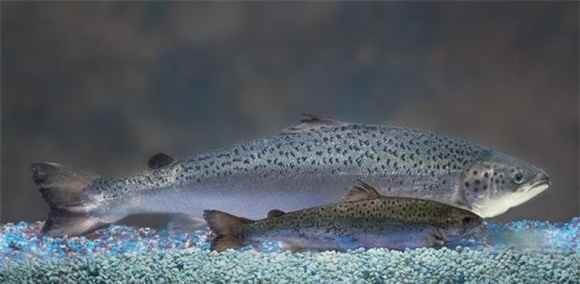
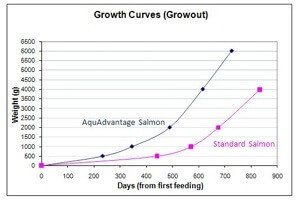
The genetically modified salmon are produced by AquaBounty Technologies, based in Maynard, Massachusetts. Their AquAdvantage salmon are Atlantic salmon that combine a growth hormone gene from Chinook salmon and a control gene from an eel-like creature called the ocean pout that cranks out the growth hormone. The result is that the AquAdvantage salmon grow faster, cutting the time to reach market weight by about half – 18 months compared instead of three years required by normal salmon. Despite the accelerated growth rate, the resultant salmon don’t grow to be any larger than their wild counterparts.
AquaBounty Technologies have sought FDA approval for about 17 years. The FDA had previously determined that the salmon were safe to eat but had yet to rule on whether or not they were safe for the environment. The current draft assessment will be posted on the FDA website for the next 60 days over which time the public is invited to voice concerns over the salmon. Approval is expected to follow the open comment period.
The FDA decision has infuriated some environmental and consumer groups. Andrew Kimbrell, executive director of the advocacy group Center for Food Safety that opposes farm biotechnology, calls the agency’s decision “premature and misguided.” He said in astatement that “the G.E. salmon has no socially redeeming value. It’s bad for the consumer, bad for the salmon industry and bad for the environment.” The group’s statement goes on to say that the FDA’s decision ignores the recommendations of more than 40 members of Congress for more rigorous reviews of the environmental and health effects of the salmon and near 400,000 comments from the public urging the FDA to reject the application.
A major concern among opponents is the risk that the AquAdvantage salmon could escape into the wild and outcompete normal salmon for food or mates. But the multiple layers of protection against this scenario has led the FDA to call the risk “extremely remote.”
A combination of proteins taken from the Chinook salmon and the ocean pout cause it to grow twice as fast as wild salmon. The abnormal growth rate has raised concerns among consumer groups.
First, the salmon would be reared inside inland tanks in Panama that are equipped with multiple barriers to prevent escape. And even if some salmon do manage to pass the barriers the surrounding Panamanian waters would be too warm or salty for the Atlantic fish to survive (eggs are taken from plants on Prince Edward Island, Canada). Lastly, the AquAdvantage salmon will be sterilized and unable to breed, although the sterilization procedure is acknowledged to not be foolproof.
AquaBounty rejects the environmental risk argument and assert that the accelerated growth of their fish and the shortened time to market actually decrease their environmental impact by enabling them to be grown in inland tanks instead of ocean pens that can wear on their ocean surroundings.
It’s important to point out that the FDA only assessed how the salmon might affect surrounding environs in the US, but not in Panama or Canada.
In addition to environmental concerns, opponents are concerned that the FDA’s previous assessment that the AquAdvantage salmon are safe to eat was not thorough enough.
The FDA will take some time, perhaps a few months, to consider comments from consumers before making a final decision. If they maintain their current stance that the salmon are safe an additional approval would then allow the salmon to be sold in the US. Ronald Stotish, AquaBounty’s chief executive, told the New York Times that if the fish are approved next year the genetically modified fish could reach American dinner tables by late 2013. Initial supplies would be limited given that the Panama farm is currently the only one growing the fish. But AquaBounty plans on selling the modified eggs to other fish farms to boost their salmon supply.
The FDA decision is a major victory for genetically modified foods. If the fish do end up on dinner plates across the US – and it certainly appears as though they will – the AquAdvantage salmon could pave the way for genetically modified foods of all kinds. No doubt we are in for a prolonged battle between opposition groups and companies like AquaBounty working to be major players in a potentially extremely profitable market. The battle with play out on our dinner plates as the foods are shown to be safe for us or not, and at the fish farms and crop fields as they are shown to be safe for the environment or not. It’ll be a grand experiment with implications for the future of our food, and with heavily vested interests on all sides.
-- 
-- 
~~~~~~~~~~~~~~~~~~~~~~~~~~~~~~~~~~~~~~~~~~~~~~~~~~~~~~~~~~~~~
"Ethics" is simply a last-gasp attempt by deist conservatives and
orthodox dogmatics to keep humanity in ignorance and obscurantism,
through the well tried fermentation of fear, the fear of science and
new technologies.
 
There is nothing glorious about what our ancestors call history, 
it is simply a succession of mistakes, intolerances and violations.
 
On the contrary, let us embrace Science and the new technologies
unfettered, for it is these which will liberate mankind from the
myth of god, and free us from our age old fears, from disease,
death and the sweat of labour.
 
Rael
~~~~~~~~~~~~~~~~~~~~~~~~~~~~~~~~~~~~~~~~~~~~~~~~~~~~~~~~~~~~~~
 
Tell your friends that they can subscribe to this list by sending an email to:
subscribe@rael-science.org
- - -
To unsubscribe, send an email to:
unsubscribe@rael-science.org
- - -


[rael-science] Antibiotics don’t help lower respiratory tract infections‏


~~~~~~~~~~~~~~~~~~~~~~~~~~~~~~~~~~~~~~~~~~~~~~~~~~~~~~~~~~~~~~~~
The Raelian Movement
for those who are not afraid of the future : http://www.rael.org   
~~~~~~~~~~~~~~~~~~~~~~~~~~~~~~~~~~~~~~~~~~~~~~~~~~~~~~~~~~~~~~~~

Source: http://www.washingtonpost.com/national/health-science/antibiotics-dont-help-lower-respitaory-tract-infections/2012/12/24/c92fd0de-4862-11e2-820e-17eefac2f939_story.html

Antibiotics don’t help lower respiratory tract infections

THE QUESTION When a nagging cough indicates a lower respiratory tract infection, treatment often includes antibiotics such as amoxicillin. Does this actually help?
THIS STUDY involved 2,061 adults (average age, 49) with lower respiratory tract infections, other than pneumonia, who had coughing as a primary symptom. They were randomly assigned to take amoxicillin (1 gram) or a placebo three times a day for a week. Virtually no difference was found between the two groups in how long symptoms lasted or how severe those symptoms were. New symptoms developed in 16 percent of those taking amoxicillin, compared with 19 percent of the others. Side effects, which included nausea, diarrhea and a rash, were more common in the amoxicillin group: 29 percent vs. 24 percent of those taking the placebo. Three people were hospitalized, two from the placebo group and one taking amoxicillin.
WHO MAY BE AFFECTED? Adults with lower respiratory tract infections, such as bronchitis, which generally have coughing as the telltale sign. Although occasional coughing is normal, persistent coughing may signal a respiratory infection.
CAVEATS Some of the data came from records kept by the participants. The findings do not apply to people with pneumonia.
FIND THIS STUDY Dec. 19 online issue of the Lancet.
LEARN MORE ABOUT coughs at www.nhlbi.
nih.gov/health
. Learn about bronchitis at www.mayoclinic.com (click “Diseases and Conditions”).
The research described in Quick Study comes from credible, peer-reviewed journals. Nonetheless, conclusive evidence about a treatment's effectiveness is rarely found in a single study. Anyone considering changing or beginning treatment of any kind should consult with a physician.

-- 
-- 
~~~~~~~~~~~~~~~~~~~~~~~~~~~~~~~~~~~~~~~~~~~~~~~~~~~~~~~~~~~~~
"Ethics" is simply a last-gasp attempt by deist conservatives and
orthodox dogmatics to keep humanity in ignorance and obscurantism,
through the well tried fermentation of fear, the fear of science and
new technologies.
 
There is nothing glorious about what our ancestors call history, 
it is simply a succession of mistakes, intolerances and violations.
 
On the contrary, let us embrace Science and the new technologies
unfettered, for it is these which will liberate mankind from the
myth of god, and free us from our age old fears, from disease,
death and the sweat of labour.
 
Rael
~~~~~~~~~~~~~~~~~~~~~~~~~~~~~~~~~~~~~~~~~~~~~~~~~~~~~~~~~~~~~~
 
Tell your friends that they can subscribe to this list by sending an email to:
subscribe@rael-science.org
- - -
To unsubscribe, send an email to:
unsubscribe@rael-science.org
- - -
 

[rael-science] As Biodiversity Declines, Tropical Diseases Thrive‏


~~~~~~~~~~~~~~~~~~~~~~~~~~~~~~~~~~~~~~~~~~~~~~~~~~~~~~~~~~~~~~~~
The Raelian Movement
for those who are not afraid of the future : http://www.rael.org   
~~~~~~~~~~~~~~~~~~~~~~~~~~~~~~~~~~~~~~~~~~~~~~~~~~~~~~~~~~~~~~~~

Source: http://www.npr.org/blogs/health/2012/12/29/168210441/as-biodiversity-declines-tropical-diseases-thrive?sc=17&f=1128

As Biodiversity Declines, Tropical Diseases Thrive

by Eliza Barclay
December 29, 2012 7:42 AM
Mosquitoes like this one can carry the virus that causes dengue fever, which may become a bigger problem in some regions as biodiversity is lost.
James Gathany/CDC Public Health Image Library
Global health advocates often argue that the tropical diseases that plague many countries, such as malaria and dengue, can be conquered simply with more money for health care – namely medicines and vaccines.
But a new paper is a reminder that ecology also has a pretty big say in whether pathogens thrive or die off. Using a statistical model, researchers predicted that countries that lose biodiversity will have a heavier burden of vector-borne and parasitic diseases. Their results appear this week in PLoS Biology.
"The general logic is that the more organisms you have out there, the more things there are that can interrupt the life cycle of disease, and the less concentration you'll have of any vector," Matthew Bonds, a researcher at Harvard Medical School and the lead author of the paper, tells Shots.
But plants, mammals and birds are disappearing fast – one-third of the world's species are now threatened with extinction, according to the United Nations. And when the creatures that prey on mice, mosquitoes or other vectors of disease go, parasites and other disease-causing agents discover it's a lot easier to survive.
Scientists have already shown that's one reason for the explosion of Lyme disease in the Northeast United States. A 2002 paper in the Proceedings of the National Academy of Sciences found that if you have a rich community of tick hosts, like squirrels, mice and other small mammals, the disease is diluted among them. But if the habitat is degraded, and ticks carrying Lyme have only white-footed mice as hosts, the disease risk to humans can rise dramatically.
West Nile encephalitis, a mosquito-borne disease, has also ripped through communities with the help of surging bird populations, according to a study in Nature.
Because of studies like these, Bonds wanted to see how strong the causal relationship was between biodiversity and 12 common vector-borne and parasitic diseases on a global scale. So he chose statistical methods from a new field that blends economics and ecology called "macroecology" to figure out how biodiversity loss affected disease burden, controlling for several different variables.
Ultimately, he found that if a country with a relatively high biodiversity (such as Indonesia) were to lose 15 percent of it, the burden of disease would be expected to increase by about 30 percent. His models also showed how diseases have a significant impact on economic development and explain differences in income between tropical and temperate countries.
"I think what this shows is that the burden of disease is really important, and it's not just driven by health care," he says. "These diseases spend so much of their life-cycles outside of humans, so they're part of the physical environment."
Nevertheless, human disease is still generally viewed as a medical or public health problem — not an ecological problem. Policymakers only just beginning to talk about conservation as they plan for public health.

-- 
-- 
~~~~~~~~~~~~~~~~~~~~~~~~~~~~~~~~~~~~~~~~~~~~~~~~~~~~~~~~~~~~~
"Ethics" is simply a last-gasp attempt by deist conservatives and
orthodox dogmatics to keep humanity in ignorance and obscurantism,
through the well tried fermentation of fear, the fear of science and
new technologies.
 
There is nothing glorious about what our ancestors call history, 
it is simply a succession of mistakes, intolerances and violations.
 
On the contrary, let us embrace Science and the new technologies
unfettered, for it is these which will liberate mankind from the
myth of god, and free us from our age old fears, from disease,
death and the sweat of labour.
 
Rael
~~~~~~~~~~~~~~~~~~~~~~~~~~~~~~~~~~~~~~~~~~~~~~~~~~~~~~~~~~~~~~
 
Tell your friends that they can subscribe to this list by sending an email to:
subscribe@rael-science.org
- - -
To unsubscribe, send an email to:
unsubscribe@rael-science.org
- - -


[rael-science] Planets and their sun grow together‏


~~~~~~~~~~~~~~~~~~~~~~~~~~~~~~~~~~~~~~~~~~~~~~~~~~~~~~~~~~~~~~~~
The Raelian Movement
for those who are not afraid of the future : http://www.rael.org   
~~~~~~~~~~~~~~~~~~~~~~~~~~~~~~~~~~~~~~~~~~~~~~~~~~~~~~~~~~~~~~~~

Source: http://www.sciencenews.org/view/generic/id/347345/description/Planets_and_their_sun_grow_together

Planets and their sun grow together

Radio telescopes reveal how nascent bodies funnel gas to their parent star
Enlarge
A TWIST ON STARS
In this illustration, gaseous streams spiral in from a disk surrounding the young star HD 142527. Two protoplanets (seen as tiny knots within the streams) may be funneling the gas inwards to the star.

Some 450 light-years from Earth, embryonic planets may be feeding tendrils of gas to the newborn star they orbit. The discovery helps explain how a young star can grow even as budding planets suck up much of the gas and dust around it. Without the tendrils replenishing it, the star’s supply of gas would disappear in less than a year.
Jupiter and Saturn may have done something similar for the sun in its early days, 4.5 billion years ago. “This is one of the nearest examples of the birth of a solar system,” says Simon Casassus, an astronomer at the University of Chile. He and his colleagues describe the finding online January 2 in Nature.
The star in question is named HD 142527, in the southern constellation Lupus. It’s about twice the mass of the sun but far younger, only about 2 million years old. Astronomers knew it was surrounded by a swirling disk of gas and dust, which has a big clearing in it from about 10 times to 140 times the Earth-sun distance. They think a big budding planet — something like Jupiter in its very early days — might orbit its star at about 90 times the Earth-sun distance, clearing out a gap like a snowplow shoveling roads.
Casassus’ team looked at this gap using the ALMA array of radio telescopes in Chile, which can detect faint emissions from gases such as carbon monoxide. The team found some of this gas drifting through the gap — probably leftover stuff that the protoplanet hadn’t cleared away, Casassus says.
More intriguingly, denser gas formed several filaments stretching across the gap. These streamers are almost certainly guided and shaped by protoplanets embedded within them, Casassus says.
The filaments are faint, says University of Hawaii astronomer Jonathan Williams, but “my gut reaction is that their interpretation is probably correct and that this is an exciting result.”
Simulations of how the gas might flow suggest not one but at least two big protoplanets surround the star. One, of around 10 Jupiter masses, probably orbits at the expected 90 times the Earth-sun distance. A second, of around 4 Jupiter masses, may orbit closer in, at around 40 times the Earth-sun distance. “At this point, we can’t tell how many objects orbit the star,” cautions Sally Dodson-Robinson, an astronomer at the University of Texas at Austin.
Astronomers haven’t yet directly spotted any protoplanets around HD 142527, but they keep looking. The Nature paper relies on one hour’s worth of observations from ALMA; Casassus has six more hours of data that should be arriving on his desk within the next few weeks. “There’s lots more to come,” he says.

-- 
-- 
~~~~~~~~~~~~~~~~~~~~~~~~~~~~~~~~~~~~~~~~~~~~~~~~~~~~~~~~~~~~~
"Ethics" is simply a last-gasp attempt by deist conservatives and
orthodox dogmatics to keep humanity in ignorance and obscurantism,
through the well tried fermentation of fear, the fear of science and
new technologies.
 
There is nothing glorious about what our ancestors call history, 
it is simply a succession of mistakes, intolerances and violations.
 
On the contrary, let us embrace Science and the new technologies
unfettered, for it is these which will liberate mankind from the
myth of god, and free us from our age old fears, from disease,
death and the sweat of labour.
 
Rael
~~~~~~~~~~~~~~~~~~~~~~~~~~~~~~~~~~~~~~~~~~~~~~~~~~~~~~~~~~~~~~
 
Tell your friends that they can subscribe to this list by sending an email to:
subscribe@rael-science.org
- - -
To unsubscribe, send an email to:
unsubscribe@rael-science.org
- - -